

New Zealand Wildlife: Meet the 27 Animals on Our Wildlife Map
New Zealand wildlife doesn’t play by normal rules. The country has no native land mammals, apart from two small bats. Birds filled the gap, and plenty of them gave up flying altogether. Add whales, dolphins, seals and penguins, and you get a country where the best animal encounters often sit a short drive from a town with decent coffee.
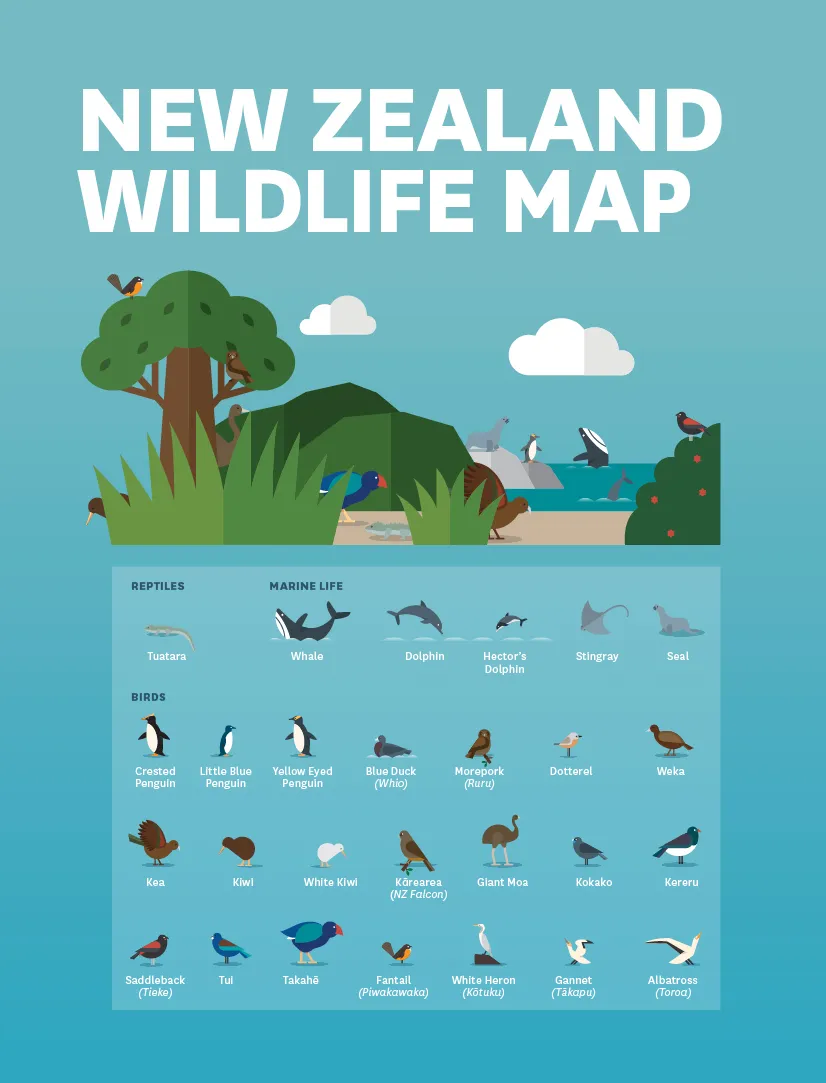
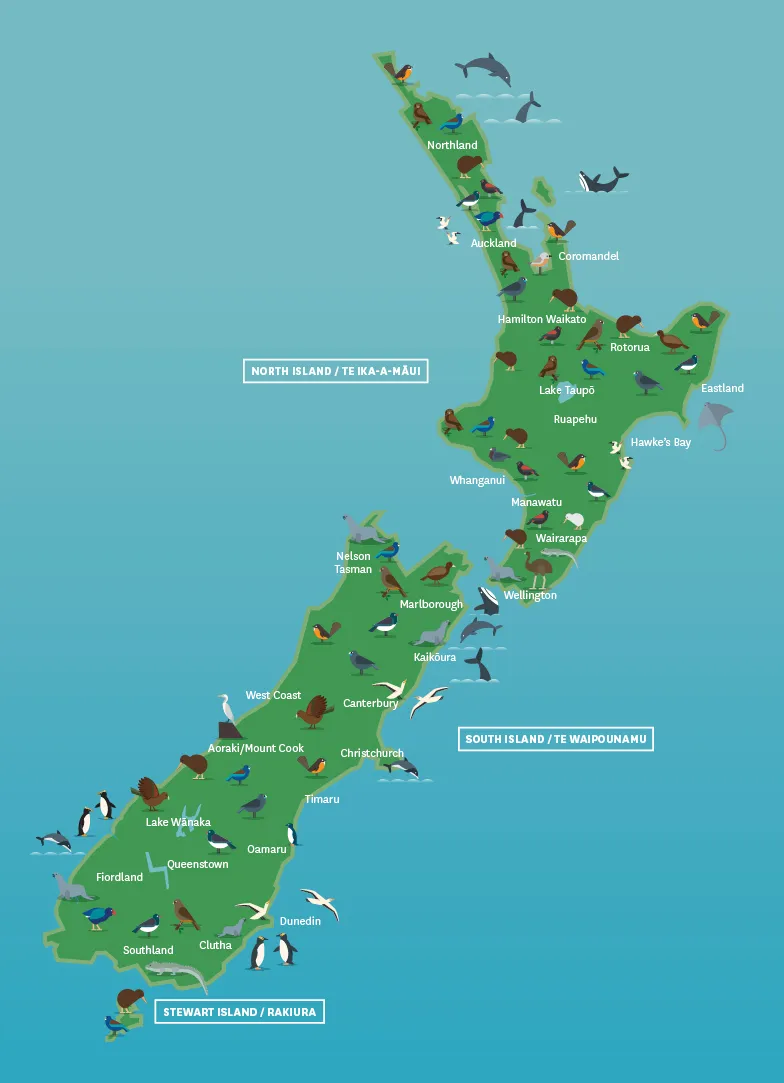
This guide covers all 27 animals on our New Zealand wildlife map. You’ll find what each one is, where to see it, and a few tips that improve your odds. A region-by-region summary follows the animal profiles, so you can build a route as you read.
Ancient Survivors and Lost Giants
Tuatara
Tuatara look like lizards. They’re not. They belong to their own ancient reptile order, and their family tree stretches back to the age of the dinosaurs. They live slowly, breed slowly and can outlast most things on the planet, except rats.
That’s why wild tuatara live on predator-free islands. Most visitors meet them in sanctuaries. Zealandia in Wellington has them, and so does Tiritiri Matangi Island in the Hauraki Gulf, where 60 tuatara were released in 2003. In Hawke’s Bay, tours of the Cape Sanctuary near Cape Kidnappers include tuatara and giant wētā. Look near burrow entrances, move slowly and never touch.
Where: Wellington, Auckland’s gulf islands and Hawke’s Bay.
Giant Moa
You can’t see a live moa. They’re gone. But the story still grabs people, so museums are the next best thing.
The South Island giant moa stood up to three metres tall and weighed around 240 kilograms. It had no wings at all, not even tiny ones. Its only predator was Pouākai, Haast’s eagle, a giant with a wingspan of roughly 2.6 metres that dropped on moa from above. Both disappeared after people arrived.
See a giant moa skeleton at the entrance to Canterbury Museum in Christchurch. Te Papa in Wellington shows life-size models of a moa and Pouākai, and Otago Museum in Dunedin displays a Haast’s eagle skeleton. Rainy day? Perfect.
Where: Christchurch and Canterbury, Wellington and Dunedin and Otago. Browse more museums across the country.
Marine Wildlife: Whales, Dolphins, Seals and Rays
Whales
Kaikōura is the place. A deep underwater canyon sits close to shore, and it pulls in sperm whales all year round. Those whales live here. They’re not just passing through. Whale Watch Kaikōura runs sailings every day except Christmas Day, so you can book almost any week of the year.
The cast changes with the seasons. Humpbacks migrate past in winter, around June and July. Orca, pilot whales and the occasional blue or southern right whale also turn up. Sea a bit rough? The first sailing of the day is usually the calmest, and some operators fly helicopters or small planes instead.
You can sometimes spot whales in the Bay of Islands too. There are no dedicated whale tours there, but a dolphin cruise might get lucky. Stay at least 50 metres from any whale, and never swim with them. The rules are strict for good reason.
Where: Kaikōura first, then Northland and the Bay of Islands.
Dolphins
Thirteen dolphin species swim in New Zealand waters. The common ones are dusky, bottlenose and Hector’s. Dolphins show up all year, but December to March is the peak.
In the Bay of Islands, cruises out of Paihia and Russell find dolphins on most trips. Kaikōura, dusky dolphin pods can number from 100 to 800 animals, which looks wild from a boat. In the Hauraki Gulf, common dolphins visit too.
You can swim with dolphins on some tours, but not with pods that include very young calves. Boats must slow to idle speed within 300 metres. Good operators follow these rules without being asked.
Where: Northland, Kaikōura, Auckland and Akaroa. See our boat cruises and water activities.
Hector’s Dolphin
Hector’s dolphin is the world’s smallest and rarest marine dolphin. It’s about 1.5 metres long, has a rounded dorsal fin like a Mickey Mouse ear, and lives nowhere else on Earth.
Akaroa Harbour on Banks Peninsula is the easiest place to meet one, about 90 minutes from Christchurch. Tours here run swim and boat trips. They fill up early in summer, so book ahead. Hector’s dolphins also live off Kaikōura and in the Marlborough Sounds, usually in small groups of four to eight.
Where: Christchurch and Canterbury, Kaikōura and Marlborough.
Seals
New Zealand fur seals sprawl on rocks all around the coast. They snooze, scratch and sometimes fight. Rarer New Zealand sea lions haul out on Otago Peninsula beaches and in the Catlins.
Good seal spots include the Kaikōura Peninsula Walkway (free), Adele Island in Abel Tasman National Park and Cape Palliser at the bottom of the North Island. Fiordland cruises often pass colonies too.
Treat seals like wild animals, because they are. Stay at least 20 metres away, don’t get between a seal and the sea, and keep dogs far away. A startled seal can bite, and it moves faster than you’d guess.
Where: Nelson Tasman, Wellington and Wairarapa, Kaikōura, Dunedin and Fiordland.
Stingrays
Three kinds of ray swim in New Zealand: the eagle ray, the short-tailed stingray and the long-tailed stingray. They glide over sandy flats, and in the right spots you can stand among them.
Dive Tatapouri near Gisborne runs a reef ecology tour where you wade into thigh-deep water while eagle rays and short-tailed stingrays swim around your legs. Goat Island Marine Reserve north of Auckland is great for snorkelling with rays, especially from December to April when the water is warmest. In summer, short-tailed stingrays also gather at Cathedral Cave in the Bay of Islands and sometimes near Paihia wharf. Poor Knights Islands off Northland draws big groups too.
Don’t stand on a ray or chase one. If it lifts its tail, back off. That’s a warning.
Where: Gisborne and Eastland, Auckland and Northland.
Penguins and Seabirds
Little Blue Penguin (Kororā)
The little blue is the smallest penguin on Earth. It spends the day at sea, then waddles ashore at dusk. Watching a raft of them hop out of the surf is a proper highlight.
Oamaru Blue Penguin Colony is the most accessible spot, with grandstand seating and artificial nesting boxes. Blue Penguins Pukekura on Otago Peninsula runs night-time viewing, and Flea Bay on Banks Peninsula holds the largest mainland colony. Timaru’s Caroline Bay also has visitors.
Keep at least 50 metres away from wild penguins and never use flash. Don’t block their path to the water either. Chicks are waiting for dinner.
Where: Dunedin and Otago, Oamaru, Banks Peninsula and Timaru.
Yellow-Eyed Penguin (Hoiho)
The hoiho is one of the rarest penguins in the world. It stands about 75 centimetres tall, with pale yellow eyes and a yellow band across its head. Unlike little blues, it comes ashore during the day, usually late afternoon.
On Otago Peninsula, guided visits through places like Penguin Place and operators such as OPERA give you the best odds. Sandfly Bay is another option. In the Catlins, Curio Bay offers free viewing from the hilltop around dusk, and Bushy Beach in Oamaru has viewing hides. You might see only one or two birds. That’s normal.
Where: Dunedin and Otago, the Catlins, Oamaru and Stewart Island. See our Southland activities for the Catlins.
Fiordland Crested Penguin (Tawaki)
Tawaki is the shy one. It’s the world’s second-rarest penguin, around 60 centimetres tall, with a yellow eyebrow that sticks up when it’s annoyed. It nests in coastal rainforest, so you rarely see it.
Your best bet is Monro Beach, about 30 kilometres from Haast on the West Coast. A cruise on Milford Sound or Doubtful Sound sometimes turns one up. Be ready for a miss. Bring binoculars, keep your distance and enjoy the rainforest while you wait.
Where: Fiordland and the West Coast.
Albatross (Toroa)
Albatross wingspans stretch close to three metres. They glide for hours without a single flap, and they barely touch land except to breed.
Taiaroa Head on Otago Peninsula holds the only mainland royal albatross colony in the world. The Royal Albatross Centre runs guided viewing from an observatory above it. Go on a windy day, because that’s when the birds fly. Wandering albatross also join whale-watching trips out of Kaikōura.
Where: Dunedin and Otago, and Kaikōura.
Gannet (Tākapu)
Gannets dive from the sky like arrows and hit the water at stunning speed. They also nest in noisy, crowded colonies that smell like fish. You’ll love it.
Cape Kidnappers in Hawke’s Bay holds the largest mainland gannet colony in the world, with more than 20,000 birds at peak. Tours reach it overland across a farm station or along the beach at low tide. Muriwai near Auckland has a smaller colony where you look down on the nests from a platform. Aim for September to March, with the busiest stretch between November and February.
Where: Hawke’s Bay and Auckland.
White Heron (Kōtuku)
Kōtuku is tall, elegant and super rare. Only 150 to 200 live in New Zealand, and they all nest in one place: Waitangiroto Nature Reserve near Whataroa on the West Coast. Māori legend says seeing one in your lifetime brings good luck.
Only White Heron Sanctuary Tours runs trips there. You take a short guided walk of about 800 metres through kahikatea forest to a viewing hide. The nesting season runs from mid-September to the end of February. Tours leave from Whataroa, 30 kilometres north of Franz Josef.
Where: West Coast.
New Zealand Dotterel (Tūturiwhatu)
Dotterels are small, speckled shorebirds that nest right on the sand. Parents scrape a shallow hole, lay three eggs between August and September, and defend it with some of the best acting you’ll ever see. They fake a broken wing to lure you away.
You’ll find them on east coast beaches, around the Hauraki Gulf and on Coromandel beaches. Respect any fenced-off areas and keep your dog on a lead. Those fences protect nests that are nearly invisible. See our guide to the best New Zealand beaches and the Coromandel Peninsula.
Where: Auckland, Coromandel and North Island east coast beaches.
Kiwi, Parrots and Forest Birds
Kiwi
The kiwi is New Zealand’s national bird, and it’s a weirdo. It can’t fly, it hunts at night, and it sniffs out worms with nostrils on the end of its beak. Five species live here: North Island brown, great spotted, little spotted, rowi and tokoeka.
Want a wild one? Go to Stewart Island, where roughly 20,000 tokoeka live. The Wild Kiwi Encounter takes you by boat to the coast and along a forest walk. Your odds are good. Mason Bay is another good option for trampers. At Ōkārito on the West Coast, night tours search for rowi, the rarest kiwi.
Prefer a sure thing? Several sanctuaries and kiwi houses keep birds in nocturnal enclosures. Try Ōtorohanga Kiwi House in the Waikato, Rotorua’s kiwi hatchery, Pūkaha in Wairarapa, Willowbank and Orana in Christchurch, the West Coast Wildlife Centre in Franz Josef and Queenstown Kiwi Park. Zealandia and Kāpiti Island offer little spotted kiwi, and Trounson Kauri Park in Northland has night walks for North Island brown kiwi. Never shine white light at a kiwi.
Where: Stewart Island, Waikato, Rotorua and Wellington. Our secret islands guide covers Kāpiti and Ulva.
White Kiwi
Pūkaha National Wildlife Centre in Wairarapa became famous for Manukura, a rare white kiwi hatched in 2011. Visitors came from all over the world to see her. One recent guide reports that Manukura died in 2020, so check with Pūkaha about which white kiwi, if any, are on show before you plan a trip around one.
The centre still makes a fine stop. You’ll meet kākā, kākāriki, kererū and other native birds in a free-flight aviary. It’s about 1 hour 45 minutes north of Wellington via Masterton, and roughly an hour from Palmerston North.
Where: Wairarapa. See Wellington and Wairarapa.
Kea
Kea are the world’s only alpine parrot, and they’re criminals. They unzip bags, pry rubber from cars and steal anything shiny. They also look stunning, with olive-green feathers and flashes of orange under the wings.
Arthur’s Pass village is the easiest spot. Otira viaduct lookout, five minutes up the road, is another. Heading to Milford Sound? Kea gather around the Homer Tunnel and at Monkey Creek. You’ll also find them in Aoraki / Mount Cook National Park, especially around the village.
Don’t feed them. Nuts and seeds can cause metabolic bone disease, and bold birds that expect food end up in trouble. Zip your bags and keep your lunch in the car.
Where: Arthur’s Pass, Fiordland and Mount Cook and Mackenzie. See the best national park tours.
Weka
Weka are flightless, brown and incredibly nosy. They’ll investigate your boots, your picnic and your campsite, often all at once. Think chicken with ninja skills.
Stewart Island is famous for them, and they also roam Ulva Island. Smaller populations live in parts of the West Coast, the Marlborough Sounds and around Gisborne. Don’t feed them. Watch your gear too, because they steal.
Where: Stewart Island, West Coast, Marlborough and Eastland.
Kōkako
You hear a kōkako before you see one. The song is deep, haunting and organ-like, and it drifts through the forest like a ghost. The North Island kōkako has blue wattles, which look like little blue earrings.
Tiritiri Matangi Island is the easiest place to find one, and Zealandia in Wellington has them too. Go early in the morning, stay quiet and listen. This is a patient bird for patient visitors.
Where: Auckland’s gulf islands and Wellington.
Tīeke (Saddleback)
The tīeke wears a chestnut saddle across its black back and has bright red wattles. It hops, bounces and chatters like it owns the forest, and it’s part of the same ancient wattlebird family as the kōkako.
North Island saddleback live on Tiritiri Matangi, and the South Island saddleback is easiest to find on Ulva Island. Look low in the undergrowth and along track edges.
Where: Auckland’s gulf islands, Stewart Island and Ulva Island.
Takahē
Takahē was declared extinct, and then Geoffrey Orbell found a small population in Fiordland’s Murchison Mountains on 20 November 1948. It’s a big, flightless, midnight-blue bird with a thick red beak. It looks like a purple swamphen on steroids.
Te Anau Bird Sanctuary, run by the Department of Conservation, keeps takahē for visitors to see. You can also meet them on Tiritiri Matangi Island, at Zealandia and at Pūkaha. Give them space. These birds are rare, and every single one counts.
Where: Fiordland, Auckland’s gulf islands and Wellington.
Blue Duck (Whio)
Whio live on fast, clear mountain rivers, and they’re built for it. They have rubbery bills for scraping insects off rocks and pairs defend 1 to 5 kilometres of river each. You’ll know them from the $10 note.
The Tongariro River near Whakapapa is a reliable place, and tours such as Tongariro River Rafting’s Blue Duck Experience take you out on the water. In Fiordland, try the Milford Road, especially Monkey Creek. Stand on the bank, stay still and scan the white water.
Where: Ruapehu, Taupō and Fiordland.
Kererū
The kererū is a big, glossy native pigeon with a white chest and a heavy wing beat. It’s also one of the few birds big enough to swallow large native fruit, so it plants the forest as it goes. In spring, it sometimes gorges on fermented berries and wobbles off its branch. Really.
You’ll see kererū in city parks, forests and gardens around the country. Zealandia and Pūkaha both have good numbers. Look up, because they like the tops of trees.
Where: Everywhere. Check our nature experiences.
Tūī
Tūī look black from a distance. Up close, they shine blue and green, with a pair of white tufts at the throat. They mimic sounds and sing complicated songs that mix whistles, clicks and coughs.
They love nectar. Watch kōwhai and flax flowers in spring and you’ll almost certainly find one. Tūī live in forests, suburbs and city centres from Northland to Stewart Island, so you won’t need a tour.
Where: Everywhere.
Fantail (Pīwakawaka)
Fantails are tiny, friendly and always moving. They flit around your feet on a bush walk, snapping up the insects you disturb. That fanned tail is hard to miss.
You’ll meet one on almost every forest track in the country. Take a short walk and slow down. Your walking and hiking days will have company, and a few of the Great Walks are packed with them.
Where: Everywhere.
Morepork (Ruru)
The ruru is the last native owl in New Zealand. Its call sounds exactly like its English name: “more-pork, more-pork.” You’ll hear it at night in forests, farms and even suburban gardens.
Spotting one takes patience. Join a night tour at Zealandia, or stay near a hut or campsite and listen after dark. Stewart Island is another fine place. Use a red torch, not a white one.
Where: Everywhere, with sanctuary night tours in Wellington.
Kārearea (New Zealand Falcon)
The kārearea is New Zealand’s only falcon and its only remaining native daytime bird of prey. It’s fast, tough and fearless. It hunts other birds, and it’ll dive-bomb you if you wander near a nest.
Wild falcons are hard to find, though you might spot one over high-country valleys in Canterbury, Fiordland or Nelson Lakes. For a sure sighting, visit Wingspan National Bird of Prey Centre in Rotorua, which runs flying displays.
Where: Rotorua, plus the high country around Mount Cook and Mackenzie.
New Zealand Wildlife by Region
Want to plan by place instead of by animal? Here’s what each region offers.
Northland and the Bay of Islands
Dolphin cruises, summer stingrays around Paihia and Cathedral Cave, and kiwi night walks at Trounson Kauri Park. Start with our Northland activities.
Auckland, Coromandel and the Hauraki Gulf
Tiritiri Matangi brings kōkako, takahē, tīeke and tuatara. Muriwai has gannets, and Goat Island has rays. Dotterels nest on Coromandel beaches. See Auckland and Coromandel.
Waikato, Rotorua, Taupō and Ruapehu
Ōtorohanga Kiwi House, Rotorua’s kiwi hatchery and Wingspan’s falcons sit within easy reach of each other. Whio live on the Tongariro River. Browse Waikato, Rotorua, Taupō and Ruapehu.
Hawke’s Bay and Eastland
Cape Kidnappers hosts the gannets and the Cape Sanctuary has tuatara. Up the coast near Gisborne, Dive Tatapouri lets you stand among stingrays. See Hawke’s Bay and Eastland.
Wellington, Wairarapa, Whanganui and Manawatu
Zealandia is a world-first fenced sanctuary in the middle of the capital, with kiwi, takahē, kōkako and tuatara. Pūkaha in Wairarapa shows native birds up close, and seals hang out at Cape Palliser. Plan around Wellington and Wairarapa and Whanganui and Manawatu.
Nelson Tasman and Marlborough
Seals at Abel Tasman, dolphins in the Marlborough Sounds and weka in the bush. See Nelson Tasman and Marlborough.
Kaikōura and Canterbury
Kaikōura rules, with sperm whales, dusky dolphins, seals and albatross. Akaroa adds Hector’s dolphins. Flea Bay is penguin territory. Christchurch brings moa skeletons, plus kiwi at Willowbank and Orana, and Arthur’s Pass is kea country. Start with Kaikōura and Christchurch and Canterbury.
The West Coast
White herons nest near Whataroa. Tawaki visit Monro Beach, and rowi live around Ōkārito. Franz Josef has the West Coast Wildlife Centre. See West Coast activities.
Mount Cook, Queenstown and Wanaka
Kea hang around Aoraki / Mount Cook, and Queenstown Kiwi Park shows kiwi in a safe setting. Check Queenstown and Wanaka.
Fiordland, Southland and Stewart Island
Takahē at Te Anau, whio and kea on the Milford Road, tawaki and dolphins on the sounds, and yellow-eyed penguins in the Catlins. Stewart Island has wild kiwi. Browse Fiordland, Southland and Stewart Island.
Dunedin, Otago and Oamaru
Royal albatross, yellow-eyed penguins, little blues and sea lions all live within a short drive of Dunedin. Oamaru adds a famous blue penguin colony. See Dunedin and Otago.
Wildlife Rules That Protect the Animals
These animals live here, and you’re a guest. The Department of Conservation (DOC) sets clear rules for marine mammals, and you can read the full guide at Sharing our coasts with marine mammals. Here are the basics:
- Seals and sea lions: Stay at least 20 metres back, and don’t block their way to the sea.
- Whales: Keep 50 metres away, and never swim with them.
- Dolphins: Swimming is allowed on some tours, but not with pods that include young calves.
- Penguins: Stay 50 metres away and skip the flash.
- Kea and weka: Don’t feed them, and secure your gear.
- Drones: Keep them more than 150 metres horizontally from any marine mammal.
- Dogs: Leave them at home near seals, penguins, dotterel nests and sanctuaries.
- Predator-free islands: Check your bags and shoes for seeds, insects and stowaway rodents.
When to See What: A Seasonal Wildlife Calendar
Wildlife keeps its own calendar. Some animals stay put all year, and others show up for a few months only.
| Season | Best for |
|---|---|
| Spring (September to November) | Kōtuku nesting begins in mid-September, gannets return to Cape Kidnappers, dotterels nest, tūī feed on spring blossom |
| Summer (December to February) | Peak dolphin season, busy gannet colonies, stingrays at Goat Island, Tiritiri Matangi ferries, long daylight |
| Autumn (March to May) | Fewer crowds, more variety of whales off Kaikōura, settled weather for island day trips |
| Winter (June to August) | Humpback whales migrating past, quiet sanctuaries, sperm whales still year-round at Kaikōura |
For more on timing, read our guide to the best time to visit New Zealand and our weather and climate page.
Plan a Wildlife Trip With Us
You can see most of these animals on a single South Island loop. Try our South Island tours, which pass Kaikōura, Mount Cook, the West Coast and Fiordland. The 7-day West Coast Wonder self-drive tour and the 11-day Glacier Wonder self-drive tour are good starting points. North Island fans can browse North Island tours.
Prefer a guide who knows the birds? Check our small group tours. Driving yourself? Read about driving in New Zealand and book a rental car. Travelling with kids? See the best activities for children.
Frequently Asked Questions About New Zealand Wildlife
What animals live in New Zealand?
New Zealand’s wildlife is mostly birds, marine mammals and reptiles. Famous residents include kiwi, kea, takahē, tuatara, penguins, albatross, whales, dolphins and seals. The only native land mammals are two species of bat.
Are there snakes in New Zealand?
No. New Zealand has no native snakes, and it has no large land predators. Visitors still need to watch out for sandflies, stingray tails and seals that feel cornered.
Where can I see a kiwi in the wild?
Stewart Island is the best place. Guided evening tours give you a good chance of seeing a tokoeka on the beach or in the forest. You can also see kiwi at sanctuaries and kiwi houses across the country.
Where is the best place to see penguins in New Zealand?
The Otago Peninsula, Oamaru and the Catlins offer the most reliable viewing. You can see little blue penguins at dusk, and yellow-eyed penguins in the late afternoon. Tawaki are much harder to find.
When is the best time to see whales in New Zealand?
Sperm whales live off Kaikōura all year, so there’s no bad month to try. Humpbacks pass through in winter, around June and July. Summer is warmer and calmer for sailing.
Can you swim with dolphins in New Zealand?
Yes, on selected tours in places like Kaikōura, Akaroa and the Bay of Islands. Operators can’t take swimmers in with pods that include very young calves. Swimming with whales isn’t allowed.
Is there a white kiwi in New Zealand?
Pūkaha in Wairarapa once housed Manukura, a famous white kiwi hatched in 2011. Reports say she died in 2020, so call the centre before you visit to confirm what’s on display.
What is New Zealand’s national bird?
It’s the kiwi. The flightless, nocturnal bird is also the nickname for New Zealanders.
Can I see New Zealand wildlife without a tour?
Plenty of animals, including tūī, fantails, kererū, seals and kea, are easy to find on your own. For rarer species like kiwi, takahē and yellow-eyed penguins, a guided visit or sanctuary improves your odds and protects the animals.
Start Planning Your New Zealand Wildlife Trip
Pick the animals you can’t miss and work backwards. Our team builds trips around your dates and interests, and you can save up to 10 per cent when you book early. Request a custom itinerary, read how to book a tour, or browse our frequently asked questions. Sort out travel insurance before you fly.