

New Zealand Weather in May: What It’s Really Like, Region by Region
New Zealand weather in May is late autumn sliding into winter. The days are cool but often bright and still, the nights are cold enough for frost across much of the South Island, and the crowds and prices are at their lowest of the year. Highs sit around 11–18°C (52–64°F), and in the Mackenzie Basin the average night-time low drops to 1°C (34°F). It’s also the month when New Zealand’s weather is hardest to pin down: May 2023 was the warmest May on record, while May 2024 was the coldest in 15 years. May 2026 was one of the driest ever recorded, with Christchurch’s Botanic Gardens receiving just 0.6 mm of rain for the whole month.
Quick answer: Most of New Zealand sits between 11°C and 18°C (52–64°F) by day in May, with nights from about 1°C (Lake Tekapo, Aoraki / Mount Cook) to 11°C (Auckland). The north and west are the wettest, the east is drier and sunnier, and frosts are common inland in the South Island. Evenings are dark by about 5:30pm. It’s a quiet, good-value month for cities, wine, hot pools and wildlife, but not the month for beaches or alpine hiking. Pack proper warm layers.
In this guide
- May Weather in New Zealand by Place: The Numbers
- Averages Lie: What May Actually Looks Like
- North Island Weather in May, Region by Region
- South Island Weather in May, Region by Region
- Late Autumn Colours in May
- The Sun: May UV in New Zealand
- Daylight in May
- What to Pack for New Zealand in May
- How to Plan Your Trip Around May Weather
- Winter Driving Starts in May
- Severe Weather: Take the Warnings Seriously
- Crowds, Prices and Booking in May
- Frequently Asked Questions About New Zealand Weather in May
- Plan Your May Trip With Us
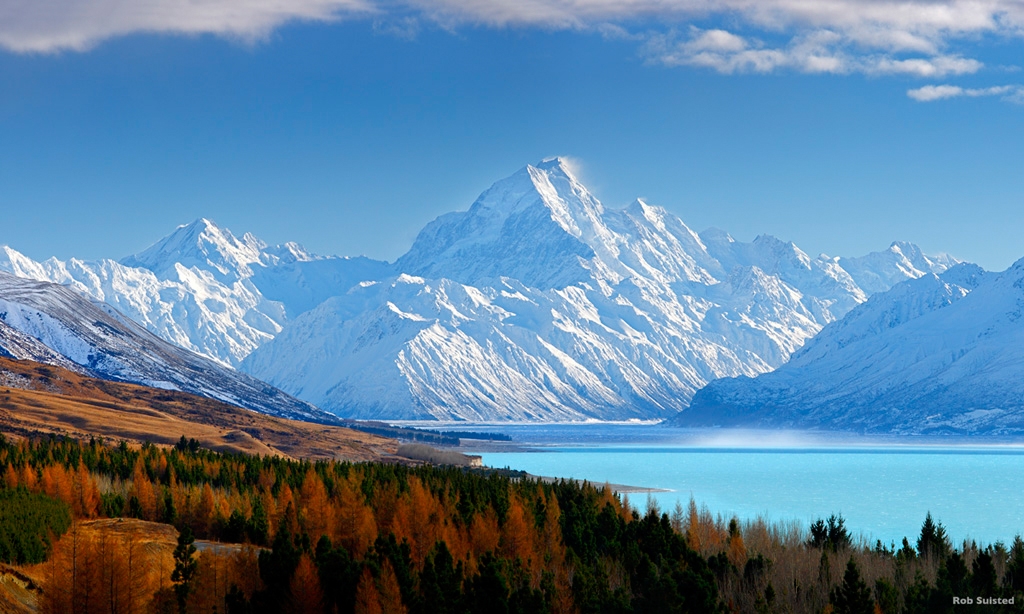
May Weather in New Zealand by Place: The Numbers
Long-term May averages for the places most visitors go. Rain days are days with at least 1 mm of rain. For scale, 25 mm is about an inch.
| Place | Avg high / low | Rain | Rain days | Sunshine (hours) |
|---|---|---|---|---|
| Bay of Islands (Kerikeri) | 18°C / 10°C (65°F / 50°F) | 174 mm | 14 | – |
| Auckland | 18°C / 11°C (64°F / 51°F) | 120 mm | 13 | 157 |
| Tauranga | 18°C / 9°C (64°F / 49°F) | 116 mm | 10 | 171 |
| Rotorua | 15°C / 7°C (59°F / 44°F) | 130 mm | 10 | – |
| Taupō | 14°C / 5°C (58°F / 41°F) | 79 mm | 9 | – |
| Napier | 17°C / 7°C (63°F / 45°F) | 62 mm | 7 | 162 |
| Wellington | 15°C / 9°C (58°F / 49°F) | 145 mm | 11 | 133 |
| Nelson | 16°C / 6°C (61°F / 43°F) | 88 mm | 7 | 176 |
| Christchurch | 15°C / 5°C (60°F / 41°F) | 60 mm | 8 | 141 |
| Lake Tekapo | 12°C / 1°C (53°F / 35°F) | 72 mm | 7 | 151 |
| Aoraki / Mount Cook | 11°C / 1°C (52°F / 34°F) | 378 mm | 14 | 86 |
| Queenstown | 13°C / 4°C (55°F / 39°F) | 91 mm | 10 | 84 |
| Dunedin | 13°C / 6°C (56°F / 43°F) | 64 mm | 10 | 113 |
| Invercargill | 13°C / 4°C (55°F / 38°F) | 106 mm | 14 | 111 |
| Stewart Island (Oban) | 12°C / 6°C (54°F / 42°F) | 155 mm | 19 | – |
| Milford Sound | 13°C / 5°C (55°F / 41°F) | 645 mm | 17 | – |
| Franz Josef | 15°C / 6°C (58°F / 43°F) | 471 mm | 15 | 92 |
| Greymouth | 15°C / 8°C (58°F / 46°F) | 210 mm | 15 | 109 |
Sources: Current Results ( https://www.currentresults.com/Weather/New-Zealand/temperature-may.php), using Earth Sciences New Zealand data for 1991–2020, plus its May rainfall (https://www.currentresults.com/Weather/New-Zealand/precipitation-may.php) and May sunshine (https://www.currentresults.com/Weather/New-Zealand/sunshine-average-may.php) tables.
The Southern Alps still divide the country. Napier, Nelson, Christchurch and Lake Tekapo are relatively dry, while Milford Sound averages 645 mm of rain in May, more than ten times Christchurch’s total. The average night in Auckland (11°C) is 10 degrees warmer than one at Lake Tekapo (1°C).
How May Compares With April
If you’ve read our April guide, here’s what changes:
- Days are 2–4°C cooler. Auckland’s high falls from 20°C to 18°C, Wellington’s from 17°C to 15°C, Christchurch’s from 18°C to 15°C and Queenstown’s from 16°C to 13°C.
- Nights fall below freezing in the high country. The average low at Lake Tekapo and Aoraki / Mount Cook drops from 4°C to 1°C, Queenstown from 6°C to 4°C and Christchurch from 8°C to 5°C.
- The north and west get wetter. Auckland goes from 87 mm to 120 mm, Kerikeri from 152 mm to 174 mm, Milford Sound from 528 mm to 645 mm and Franz Josef from 389 mm to 471 mm. Napier is the exception, easing from 81 mm to 62 mm.
- Sunshine drops sharply in the south. Queenstown falls from 136 to 84 hours, and Auckland from 181 to 157 hours.
Where Is the Weather Best in May?
If sunshine is your priority, the long-term numbers favour the top of the South Island and the east coast of the North Island:
- Blenheim and Nelson: 179 and 176 hours, with only 57–88 mm of rain. They’re the standout sunny spots.
- Tauranga: 171 hours, though it’s wetter than the east coast (116 mm).
- Napier: 162 hours and only 62 mm of rain, the driest of the main North Island places.
- Lake Tekapo: 151 hours and a modest 72 mm, but with frosty nights.
The gloomiest places are Queenstown (84 hours), Aoraki / Mount Cook (86 hours), Franz Josef (92 hours), Greymouth (109 hours), Invercargill (111 hours) and Dunedin (113 hours). That means about 3 hours of sun a day in Queenstown, so don’t count on long bright afternoons there.
Averages Lie: What May Actually Looks Like
May 2022: The third-warmest May on record, though the second half turned unsettled as intense low-pressure systems and cold fronts crossed the country.
May 2023: The warmest May on record, at a national average of 13.1°C. All five of the warmest Mays have occurred since 2011.
May 2024: The coldest May since 2009, at 9.8°C nationally (1.3°C below normal). Cold south-westerlies and clear skies brought regular inland frosts, and Cass in inland Canterbury dropped to −9.7°C.
May 2025: Warm at 11.9°C nationally, especially inland and in the south. Lake Tekapo had its sunniest May since records began in 1928, but Manapouri and Tūrangi still fell to −5.0°C.
May 2026: A record-dry month. The national average of 11.4°C was 0.3°C above normal (the 20th-warmest May), but the story was the lack of rain. Almost 30 weather stations recorded their driest May on record, and more than 40 recorded their driest or second-driest. Settled high pressure dominated, but it brought some sharp contrasts:
- Extreme dryness. Christchurch Botanic Gardens received just 0.6 mm and Cheviot had no rain at all. Whanganui and Martinborough each had only 3 mm, Taupō had 8 mm, and Auckland’s Western Springs had 25 mm (20% of normal), its driest May on record.
- Warm afternoons, cold nights. Cheviot reached 25.5°C on 7 May, and on the 8th a northerly flow brought several of the warmest May nights on record. But on 20 May, Mount Cook Airport dropped to −7.6°C.
- Fog under a lid. From 15 to 20 May, an inversion trapped low cloud and fog over parts of Central Otago and the Mackenzie Basin, so these areas had consecutive days without sunshine despite high pressure. At Lauder, the temperature stayed below 0°C for 64 consecutive hours.
- A wet and warm finish. On 30–31 May a warm, moist subtropical air mass arrived: Invercargill reached 22.0°C on the 31st, Tūrangi had a gust of 181 km/h on the 30th, and Milford Sound received 209 mm of rain on the 31st.
- A flood in the north of the South Island. On 6 May, six people were rescued from vehicles trapped in floodwater on SH6 near Canvastown in Marlborough.
Here’s how the six main centres fared that month:
| City | Mean temp | vs normal | Rainfall | % of normal | Sunshine (hours) |
|---|---|---|---|---|---|
| Auckland | 14.5°C | +0.3°C | 19 mm | 16% | 181 |
| Tauranga | 13.9°C | +0.3°C | 28 mm* | 24% | 195* |
| Hamilton | 11.5°C | −0.4°C | 21 mm | 18% | 178 |
| Wellington | 12.5°C | +0.5°C | 40 mm | 28% | 139 |
| Christchurch | 9.4°C | +0.1°C | 6 mm | 10% | 160 |
| Dunedin | 9.8°C | +0.2°C | 19 mm | 29% | 147 |
*Missing one day of data for both rainfall and sunshine.
The national average ranged from 9.8°C in 2024 to 13.1°C in 2023, a gap of more than 3 degrees in one month. Add the rain, and May is the month where you most need a Plan B. Sources: Earth Sciences New Zealand’s May 2026, May 2025, May 2024 and May 2022 summaries, and RNZ’s report on May 2023.
North Island Weather in May, Region by Region
Northland and the Bay of Islands
The warmest region in May, with highs around 18–19°C and nights of 10–11°C. It’s also wet: Kerikeri averages about 174 mm over 14 rain days. Don’t expect a beach holiday, but it’s mild, green and quiet.
Auckland and Waiheke
Mild but damp: 18°C by day, 11°C at night, about 120 mm of rain over 13 days and 157 hours of sun. Keep a waterproof handy. Museums, Waiheke wineries and food-led days work whatever the weather.
Coromandel and Bay of Plenty
Tauranga averages 171 hours of sun and highs of 18°C. The Coromandel is wetter (Whitianga 171 mm) and fresher at night (9°C). Good for hot pools, coastal walks and quiet beaches, but not for swimming.
Rotorua, Taupō and the Central Plateau
Rotorua averages 15°C by day and 7°C at night, Taupō 14°C and 5°C. Geothermal parks, Māori cultural evenings and hot pools are at their best in cold weather. The Department of Conservation treats the Tongariro Alpine Crossing as a winter route from May to October, with ice and snow: crampons, an ice axe and the skills to use them, or a guide.
Gisborne and Hawke’s Bay
The driest and sunniest part of the North Island: Napier averages 17°C by day, 7°C at night, about 62 mm of rain and 162 hours of sun. Pleasant for wineries, cafés and cycling, but nights are cold and inland frosts are common.
Wellington and the Wairarapa
Cool, wet and windy: 15°C by day, 9°C at night, about 145 mm of rain over 11 days and only 133 hours of sun. A proper windproof layer is essential. The Wairarapa is drier (Masterton 73 mm) but colder at night (6°C). Allow slack around the Cook Strait ferry and flights.
South Island Weather in May, Region by Region
Nelson, Abel Tasman and Marlborough
Still the sunniest corner of New Zealand: Nelson averages about 176 hours of sun, Blenheim 179, with highs of 16–17°C and low rainfall (Blenheim 57 mm). Nights are cold at 6°C. A pleasant time for cellar doors, cycling and coastal walks, though not immune to storms.
Kaikōura, Christchurch and Canterbury
Christchurch is cool and fairly dry: 15°C by day, 5°C at night, about 60 mm of rain over 8 days and 141 hours of sun. Frosts are normal. Arthur’s Pass is much colder and wetter, averaging 10°C by day, 2°C at night and 395 mm of rain over 14 days.
Lake Tekapo and Aoraki / Mount Cook
Tekapo is cold, dry and clear: 12°C by day, just 1°C at night, with 151 hours of sun and about 72 mm of rain. Hard frosts are normal. The long, dark, crisp nights are ideal for stargazing, but a stable high can also trap fog and low cloud for days. Mount Cook Village gets about 378 mm of rain.
Queenstown, Wānaka and Central Otago
Queenstown averages 13°C by day and 4°C at night, with about 91 mm of rain and a modest 84 hours of sun. It’s quiet, with fewer visitors, lower accommodation prices and the last of the autumn leaves. Ski fields are generally not yet open.
Dunedin, Southland and Stewart Island
Cool, cloudy and wet-ish. Dunedin averages 13°C by day, 6°C at night and 113 hours of sun. Invercargill has rain on about 14 days and Oban on Stewart Island about 19. Bring a windproof, waterproof layer and a warm hat.
Fiordland: Milford Sound and Te Anau
Milford Sound is at its wettest, averaging about 645 mm over 17 rain days, with highs of just 13°C. Rain turns the cliffs into hundreds of waterfalls, and cruises operate in all but the worst conditions, but the road can close. Manapouri, near Te Anau, is far drier (104 mm).
West Coast and the Glaciers
Franz Josef averages about 471 mm of rain with just 92 hours of sun, and Greymouth gets 210 mm. Highs are 15°C and nights 6–8°C. Give yourself two nights at the glaciers, not one, so a rained-off helicopter flight can move to the next morning.
Late Autumn Colours in May
You can still catch autumn colour in early May, but you’re at the tail end. The peak around Queenstown, Arrowtown and Lake Hayes typically runs from mid-April to early May, and Lake Hayes is usually at its best between late April and early May. By the middle of the month, wind, rain and frost will have stripped many trees. The best bets are:
- Lake Hayes, Arrowtown and the Shotover River (Queenstown area): early May is your best chance, particularly after a calm, dry week.
- Queenstown Gardens and the lakefront: colours often last into May.
- Central Otago and Wānaka: vineyards and poplars are often still golden in the first week.
If autumn colour is the main reason for your trip, aim for mid-to-late April instead, and see our April guide.
The Sun: May UV in New Zealand
UV levels are much lower in May than in summer, and in the south they are often low enough that you don’t need sun protection for much of the day. But the ozone layer is thinnest in autumn, UV is still elevated in the north on clear days, and snow and altitude amplify it. A cool day in Northland or on the volcanic plateau can still burn skin.
- SunSmart recommends sun protection whenever the UV Index reaches 3 or above, and the UV Index forecast will tell you whether that applies today.
- At altitude or on snow, apply sunscreen and wear sunglasses even in cold weather.
- Use SPF 30+ and reapply every two hours (the Cancer Society’s advice).
- Check the daily Sun Protection Alert on MetService, or the free UVNZ app.
Daylight in May
Daylight saving ended on 4 April 2027, so New Zealand is on standard time in May, and the days are short and getting shorter. Sunrise is around or after 7am almost everywhere, and sunset slides from roughly 5:30pm at the start of the month to around 5pm by the end, a little earlier in the deep south. That leaves you roughly 10 hours of daylight. Plan your driving so that you arrive before dark, especially on mountain or rural roads where frost, fog and wildlife are all hazards.
The upside is the sky: long, dark, often clear nights make May a good month for stargazing in places such as Lake Tekapo and Aoraki / Mount Cook, if you can find a clear window. The sea is cold, especially in the south, so most people stick to hot pools rather than beaches.
What to Pack for New Zealand in May
May means real winter layers, especially for the South Island. Pack for three layers, and make the warm layer a proper one.
- Base layer: thermal or merino tops and leggings.
- Warm layer: a fleece or insulated jacket, plus a beanie and gloves. Nights in Tekapo, Mount Cook, Queenstown and Invercargill average 1–4°C, with frost common.
- Rain layer: a waterproof, windproof jacket, essential for the North Island, the West Coast, Fiordland, Stewart Island and Wellington’s wind.
Add sturdy waterproof shoes, warm socks, sunglasses, lip balm and moisturiser.
How to Plan Your Trip Around May Weather
- Play to May’s strengths. Wine, food, hot pools, geothermal parks, museums, cities and wildlife are all excellent in cool weather, and you’ll often have them to yourself.
- Pair every outdoor plan with a backup, such as hot pools in Rotorua or a winery in Queenstown.
- Be flexible with scenic flights and cruises. Fog, low cloud and wind cause cancellations. Schedule them early in your stay, with a spare day behind.
- Don’t plan on beaches or high alpine walks. Great Walks season has ended, so check the Department of Conservation website first.
- Check forecasts daily on MetService, and road closures on NZTA’s Journeys site.
- Drive in daylight. With sunset around 5pm, aim to arrive by mid-afternoon.
- Check that seasonal operators are running. Some cruises, tours and attractions close or cut timetables for winter.
Winter Driving Starts in May
May to September is the winter driving season on the Milford Road (SH94), and similar conditions apply on Arthur’s Pass and the Crown Range.
- Carry snow chains when signs say so. Chains can be hired in Te Anau; practise fitting them before you set off.
- Expect frost and black ice in shaded corners, especially in the morning.
- Respect avalanche zones. The Milford Road between the Hollyford Road junction and The Chasm is a no-stopping zone.
- Check your rental agreement for road and chain restrictions.
- Check conditions every morning on NZTA Journeys. If you’re not confident, take a coach.
Severe Weather: Take the Warnings Seriously
May is generally a quieter month than April or June, but New Zealand’s weather can still turn quickly. In May 2026, a flood trapped vehicles on SH6 in Marlborough on the 6th, wind gusts reached 181 km/h at Tūrangi on the 30th, and the month ended warm, wet and windy. At the other extreme, the same month had record-low rainfall and a vegetation fire near Cambridge, a reminder that dry conditions carry their own risks.
- Subscribe to MetService warnings and follow local Civil Defence updates.
- If you’re told to evacuate or move, go straight away.
- Don’t drive through floodwater, fords or washed-out roads.
- Take fog, frost and ice seriously on mountain and rural roads.
- Be careful camping or parking beneath steep slopes, cliffs or hillsides in heavy rain.
- Make sure your travel insurance covers weather disruption. See our travel insurance guide and health and safety page.
Crowds, Prices and Booking in May
May is the quietest and best-value month for most visitors. There are no school holidays (Term 2 holidays don’t start until 3 July in 2027), the summer and autumn crowds are gone, and most accommodation, rental cars and tours cost noticeably less than in summer. You’ll often have the geothermal parks, hot pools and wineries to yourself, and it’s easier to get a table or a last-minute room, even in Queenstown. Mother’s Day falls on Sunday 9 May 2027, so popular restaurants can be busy that weekend.
The trade-offs are that the Great Walks season has finished (it typically runs to the end of April), some seasonal cruises, tours and cafés scale back or close, and most ski fields aren’t open yet. Ski areas typically open from mid-June, though in 2026 Coronet Peak and Whakapapa used snowmaking to open small beginner and snow-play areas at the end of May. If your trip is built around a particular activity, check that it’s operating on your dates.
Our guides to visiting New Zealand in May, April and June will help you compare, and our best time to visit page covers the whole year. For general background, see our weather and climate overview.
Frequently Asked Questions
What is the typical weather like in New Zealand in May?
Cool, late-autumn weather with cold nights. Most places reach 11–18°C (52–64°F) by day, with nights between about 1°C in the high country and 11°C in Auckland. The north and west are wet, the east and Nelson drier and sunnier. Frosts are common inland in the South Island, and sunset is around 5 pm to 5:30 pm.
Does it rain a lot in New Zealand in May?
It depends where you are. Napier gets about 62 mm and Christchurch about 60 mm, while Milford Sound averages about 645 mm and Franz Josef about 471 mm. May also varies enormously from year to year.
Does it snow in New Zealand in May?
Yes, in the mountains. The Southern Alps, the central plateau and the high passes can see snow, and lowland frosts are common. Snow at sea level is rare in May.
Are the ski fields open in May?
Generally no. The main commercial ski fields typically target opening from mid-June, depending on snow, though some use snowmaking to open small beginner areas earlier. Check each ski field’s website.
Can I drive the Milford Road in May?
Usually yes, but winter conditions apply. Carry chains when signs say so, check NZTA Journeys before you leave, and expect ice in shaded areas and occasional avalanche closures.
Is May a good time to visit New Zealand?
Yes, if you want quiet, good value and a focus on food, wine, geothermal attractions, hot pools, wildlife and cities. It’s not the best month for beaches, alpine hiking or the ski fields, and you’ll need warm layers. Some seasonal operators scale back, so check that what you want to do is running.
Plan Your May Trip With Us
Want a New Zealand May trip built around the weather, with the right regions on the right days and backup options in place? Browse our New Zealand tours, explore our flexible self-drive itineraries, or request a custom itinerary.