

New Zealand Weather in January: What It’s Really Like, Region by Region
New Zealand weather in January is summer at its best and its most unpredictable. The days are long, the sea is as warm as it gets and almost every road, trail and boat trip is open. But “summer” doesn’t mean one climate here. On the same January day you can be sweating at 25°C (77°F) in the Bay of Islands, reaching for a fleece at 9°C (48°F) beside Lake Tekapo that night, and watching rain bounce off Milford Sound, which collects about 667 mm in an average January.
Most weather guides give you a few averages and stop. We’ll give you the averages too, for 18 places, but also what January has actually thrown at the country in recent years, so you can plan a trip that survives a bad forecast.
Quick answer: Most of New Zealand sits between 18°C and 25°C (64–77°F) by day in January, with nights from about 7°C (mountains) to 16°C (Auckland). The east and north are sunniest. The south-west and the West Coast are by far the wettest. The UV index is extreme, so pack sunscreen no matter where you go.
In this guide
- January Weather in New Zealand by Place: The Numbers
- Averages Lie: What January Actually Looks Like
- North Island Weather in January, Region by Region
- South Island Weather in January, Region by Region
- The Sun: January UV in New Zealand
- Daylight and Sea Temperature in January
- What to Pack for New Zealand in January
- How to Plan Your Trip Around January Weather
- Severe Weather: Take the Warnings Seriously
- Crowds, Prices and Booking in January
- Frequently Asked Questions About New Zealand Weather in January
January Weather in New Zealand by Place: The Numbers
Here are the long-term January averages for the places most visitors actually go. Rain days are days with at least 1 mm of rain. For scale, 25 mm is about an inch.
| Place | Avg high / low | Rain | Rain days | Sunshine (hours) |
|---|---|---|---|---|
| Bay of Islands (Kerikeri) | 25°C / 14°C (77°F / 57°F) | 112 mm | 8 | – |
| Auckland | 24°C / 16°C (75°F / 61°F) | 58 mm | 7 | 269 |
| Tauranga | 24°C / 15°C (76°F / 60°F) | 76 mm | 6 | 269 |
| Rotorua | 23°C / 13°C (73°F / 55°F) | 94 mm | 8 | – |
| Taupō | 23°C / 12°C (73°F / 53°F) | 73 mm | 7 | – |
| Napier | 24°C / 14°C (76°F / 57°F) | 64 mm | 6 | 259 |
| Wellington | 20°C / 14°C (69°F / 57°F) | 79 mm | 7 | 232 |
| Nelson | 23°C / 14°C (73°F / 57°F) | 73 mm | 7 | 265 |
| Christchurch | 23°C / 13°C (73°F / 55°F) | 43 mm | 6 | 228 |
| Lake Tekapo | 22°C / 9°C (72°F / 47°F) | 38 mm | 5 | 267 |
| Aoraki / Mount Cook | 20°C / 9°C (69°F / 48°F) | 419 mm | 11 | 184 |
| Queenstown | 23°C / 11°C (74°F / 52°F) | 79 mm | 8 | 237 |
| Dunedin | 19°C / 12°C (66°F / 53°F) | 71 mm | 9 | 182 |
| Invercargill | 19°C / 9°C (66°F / 49°F) | 98 mm | 13 | 207 |
| Stewart Island (Oban) | 18°C / 10°C (64°F / 49°F) | 138 mm | 15 | – |
| Milford Sound | 20°C / 11°C (67°F / 51°F) | 667 mm | 15 | – |
| Franz Josef | 20°C / 11°C (68°F / 51°F) | 552 mm | 13 | 118 |
| Greymouth | 19°C / 13°C (66°F / 55°F) | 213 mm | 12 | 208 |
Sources: Current Results (https://www.currentresults.com/Weather/New-Zealand/temperature-january.php), using Earth Sciences New Zealand national climate database data for 1991–2020.
Two patterns jump out. First, the Southern Alps split the country: the east side (Christchurch, Tekapo, Blenheim) is dry and sunny, while the west side gets drenched. Second, the rainfall gap is huge over short distances. Lake Tekapo gets 38 mm in an average January. Aoraki / Mount Cook, just over an hour’s drive away, gets about ten times that.
Where Is the Weather Best in January?
If sunshine is your priority, the long-term numbers point to a few clear winners:
- Auckland and Tauranga: about 269 hours of sun, or roughly 9 hours a day.
- Lake Tekapo: 267 hours, with very little rain.
- Nelson and Blenheim: 265 and 262 hours, which is why the top of the South Island keeps winning “sunniest region” lists.
- Gisborne, New Plymouth and Napier: 259–260 hours each.
The gloomiest places on the sunshine list are Franz Josef (118 hours) and Dunedin (182 hours). That doesn’t make them bad January destinations. It just means you shouldn’t build a whole day around blue skies there.
Averages Lie: What January Actually Looks Like
An average is a polite way of hiding the extremes. Look at three recent Januaries and you get a more honest picture.
January 2023: On the 27th, Auckland Airport recorded 258 mm of rain in a single day, the wettest day in the city’s records, during the Anniversary Weekend floods.
January 2024: The opposite story in places. Masterton got just 4 mm of rain all month, its driest January since records began in 1926. Meanwhile Milford Sound collected 330 mm in one day on the 19th, and inland Canterbury dropped to −0.7°C on the 25th. Yes, a frost in January.
January 2026: Earth Sciences New Zealand called it an unsettled month with a tropical connection. The national average temperature was 17.2°C, right on the long-term average, but that number hides a wild ride:
- Napier hit 36.8°C on the 11th, its second-hottest January day on record.
- A tropical low crossed the country on 20–22 January and brought flooding, slips and record rainfall to the north and east of the North Island and the top of the South Island.
- Tauranga recorded 274 mm in a single day, and Whitianga in the Coromandel got 494 mm for the month.
- Meanwhile, the West Coast, Southland and Central Otago were drier than normal, and interior Otago ran slightly cooler than average.
Here’s how the six main centres fared that month:
| City | Mean temp | vs normal | Rainfall | % of normal | Sunshine (hours) |
|---|---|---|---|---|---|
| Auckland | 20.0°C | +0.2°C | 199 mm | 357% | 258 |
| Tauranga | 20.6°C | +0.8°C | 393 mm | 518% | 246 |
| Hamilton | 19.2°C | +0.7°C | 129 mm | 171% | 192 |
| Wellington | 16.7°C | −0.3°C | 120 mm | 152% | 208 |
| Christchurch | 16.6°C | −0.5°C | 91 mm | 215% | 179 |
| Dunedin | 15.2°C | 0.0°C | 75 mm | 106% | 165 |
Source: Earth Sciences New Zealand, Climate Summary for January 2026.
Notice that temperatures were completely normal while rainfall was wildly above normal. That is the real January risk in New Zealand: not cold, but wet spells that arrive fast. One month isn’t a forecast, but it’s a good reminder to build flexibility into your plan.
North Island Weather in January, Region by Region
Northland and the Bay of Islands
Expect highs around 24–25°C (75–77°F) and warm, humid nights of 14–16°C. Kerikeri averages about 112 mm over 8 rainy days, so showers are normal and usually pass quickly. The catch is that Northland is first in line for tropical systems. In January 2026, a subtropical low flooded parts of eastern Northland on the 18th, with up to 150–200 mm falling on the hills north of Whangārei. Don’t squeeze Cape Reinga and a Hole in the Rock cruise into the only two days you have. See Northland & Bay of Islands activities.
Auckland and Waiheke
Auckland is warm and bright: 24°C by day, 16°C at night, around 58 mm of rain and plenty of sun. The sea off the city is about 20°C, which is as warm as New Zealand swimming gets. It’s humid, and fast-moving thunderstorms and showers can crash through in the afternoon. They tend to be short, so a café stop usually fixes it. Rainy-day options are in Auckland activities.
Coromandel and Bay of Plenty
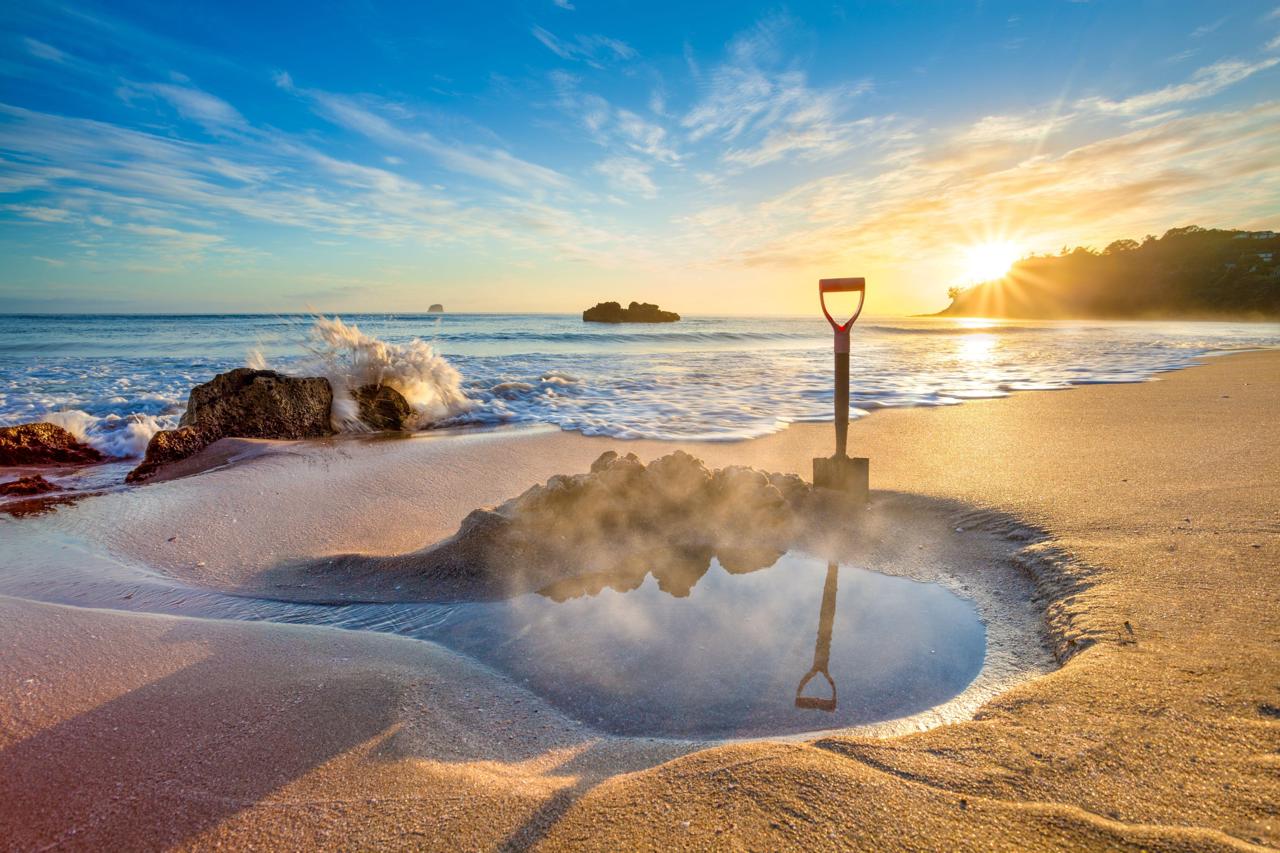
This is classic beach country, with Auckland-like temperatures (24°C highs) and similar sunshine. It’s also where the January 2026 storm hit hardest, so check the forecast before you commit to Cathedral Cove, Hot Water Beach or a Mount Maunganui sunset. Have a fallback ready, like Hobbiton or a hot pool. See Coromandel activities and Bay of Plenty activities.
Rotorua, Taupō and the Central Plateau
Inland, it’s slightly cooler, around 23°C by day and 12–13°C at night, so you’ll want a layer for the evenings. Rotorua’s geothermal parks, Māori cultural evenings and hot pools don’t care about the weather, which makes it one of the best rainy-day bases in the country. Up at Whakapapa Village on Mount Ruapehu, the average high is just 18°C with a 7°C low and about 172 mm of rain, so the Tongariro Alpine Crossing needs proper layers and a flexible day. Browse Rotorua, Taupō and Ruapehu.
Gisborne and Hawke’s Bay
This is the hot, sunny side of the North Island: highs of 24–25°C, around 260 hours of sun and only about 65 mm of rain. It’s also where the thermometer can surprise you. Napier reached 36.8°C and Hastings 36.5°C on 11 January 2026. Plan winery visits and outdoor activities for the morning, and carry water. One road note: State Highway 2 through the Waioeka Gorge, between Ōpōtiki and Gisborne, was closed by slips after severe thunderstorms in mid-January 2026, so check road status before you drive it. (It’s Day 13 of our North Island itinerary.)
Wellington and the Wairarapa
Wellington is the coolest of the main North Island cities (20°C by day, 14°C at night) and famously windy, so a light jacket is your friend even in January. Rain is moderate at about 79 mm. The Wairarapa across the hills is drier and warmer, with Masterton averaging 25°C by day. The Cook Strait can get rough, so if you’re crossing to the South Island, book ahead and don’t assume the sea will be flat. See Wellington & Wairarapa.
South Island Weather in January, Region by Region
Nelson, Abel Tasman and Marlborough
This is the sunniest corner of the South Island. Nelson gets about 265 hours of sun and Blenheim 262, with highs of 23°C and low rainfall. Abel Tasman’s golden beaches and Marlborough’s cellar doors are at their best here. Higher up in the Nelson Lakes mountains, rain is closer to 131 mm at Lake Rotoiti, so don’t assume the whole region is dry. See Nelson Tasman and Marlborough.
Kaikōura, Christchurch and Canterbury
Christchurch is dry and pleasant: 23°C by day, 13°C at night, only about 43 mm of rain over 6 days. Kaikōura is similarly dry on paper (about 47 mm), but January 2026 delivered 266 mm there, more than five times the normal. On 11 January, a thunderstorm flooded and temporarily closed the Arthur’s Pass road at Otira. Check conditions before any mountain drive. See Christchurch & Canterbury and Kaikōura & Hanmer Springs.
Lake Tekapo and Aoraki / Mount Cook
Tekapo is sunny, dry and cool at night (22°C by day, 9°C after dark), which is why it’s a great place for stargazing. Mount Cook Village, an hour or so up the road, is a different world: about 419 mm of rain and 11 rain days. Book flights and boat trips for your first day there and keep a spare day. See Mt Cook & Mackenzie.
Queenstown, Wānaka and Central Otago
Queenstown averages 23°C by day and 11°C at night, with about 79 mm of rain and 237 hours of sun. That big gap between warm afternoons and cool evenings is the thing to pack for. Hot days are great for lake swims and wine tasting, but the evening can be properly cold. In January 2026, interior Otago ran 0.5–1.2°C below average, a reminder that “summer” in the Southern Lakes isn’t guaranteed to be hot. See Queenstown and Wānaka.
Dunedin, Southland and Stewart Island
The deep south is cooler and cloudier. Dunedin averages 19°C by day, with only 182 hours of sun, and was the coolest and least sunny of the six main centres in January 2026. Invercargill is 19°C by day and 9°C at night, with rain on about 13 days. Oban on Stewart Island is 18°C with rain on about 15 days. Bring a windproof layer, and don’t write off the wildlife days. Penguins and albatross don’t mind drizzle. See Dunedin & Otago, Southland and Stewart Island.
Fiordland: Milford Sound and Te Anau
Milford Sound is one of the wettest places on earth, averaging about 667 mm in January over 15 rain days. And honestly? That’s not a disaster. Rain turns the cliffs into hundreds of temporary waterfalls, which many people say is the best way to see the fiord. Bring a proper rain jacket and insect repellent, because sandflies are part of the deal. Interestingly, Manapouri, about 20 km from Te Anau, averages only 89 mm, so the drier side of the range is close by. See Fiordland.
West Coast and the Glaciers
Franz Josef averages about 552 mm of rain in January with just 118 hours of sun, and Greymouth gets 213 mm. The honest advice is to give yourself two nights, not one, so a rained-off helicopter flight can move to the next morning. Rain is a lottery here though: in January 2026, Ōkārito logged only 46% of its normal rainfall. See West Coast.
The Sun: January UV in New Zealand
This is the part that catches visitors out. New Zealand’s UV index regularly reaches “extreme” in summer. NIWA says the maximum summer value is generally about 12 and can exceed 13 in the far north. At a UV index of 12, fair skin can be damaged in under 15 minutes. And because it’s often cool, with sea breezes and cloud, people don’t feel the burn happening.
- Use SPF 30+ and reapply every two hours (the Cancer Society’s advice).
- Cover up between 11am and 4pm, when it’s strongest.
- Wear a wide-brimmed hat and sunglasses.
- Don’t skip it on cloudy days. Cloud blocks far less UV than you’d think.
- Check the daily Sun Protection Alert on MetService, or the free UVNZ app.
Daylight and Sea Temperature in January
Days are long. At mid-January you get roughly 14½ hours of daylight in Auckland and about 15 in Queenstown, with the sun setting after 9pm in much of the south. That’s a lot of usable day for road trips, so you can do an early activity and still reach your next stop in the light.
The sea is as warm as it gets, but that’s relative. Typical January sea temperatures are around 20°C off Auckland, 17°C near Wellington and 15°C off Christchurch. In practice, northern beaches are comfortable for swimming and southern ones are bracing. Rivers and alpine lakes are colder again.
What to Pack for New Zealand in January
Forget “summer clothes”. Pack for three layers.
- Sun layer: shorts, T-shirts, a sun hat, sunglasses, SPF 30+ sunscreen, swimwear.
- Warm layer: a fleece or light puffer. Evenings in Tekapo, Queenstown and Mount Cook average 9–11°C, and Wellington’s wind cuts through.
- Rain layer: a packable waterproof jacket. If you’re heading to Milford Sound, the West Coast or Stewart Island, make it a proper one.
Add sturdy shoes for trails, insect repellent for sandflies, and a reusable water bottle. For a longer checklist, see our must-have list before your New Zealand vacation.
How to Plan Your Trip Around January Weather
- Put weather-dependent activities early. Scenic flights, glacier helicopters, Milford Sound cruises, the Tongariro Alpine Crossing and Cathedral Cove are the ones that get cancelled. Schedule them on your first day in a region, with a spare day behind.
- Pair every outdoor plan with a backup. In Rotorua it’s a geothermal park or hot pools. In Queenstown it’s a winery or a scenic flight. Anywhere, a museum works.
- Check forecasts daily. Use MetService for forecasts and warnings, and NZTA’s Journeys site for road closures.
- Don’t over-pack the itinerary. Our South Island and North Island itineraries are built with slack for this reason.
Prefer someone else to handle the logistics and the rebooking? Browse our self-drive tours, such as the 9 Day South Island Self Drive Tour, or our small group tours.
Severe Weather: Take the Warnings Seriously
Most January days are lovely. But New Zealand’s summer can also be violent, and it’s worth knowing how to respond. The January 2026 tropical low killed nine people, and six of them died when a landslide hit a holiday park at the foot of Mauao (Mount Maunganui). That is a sad reminder that evacuation notices and red warnings are not suggestions.
- Subscribe to MetService warnings and follow local Civil Defence updates.
- If you’re told to evacuate or move, go straight away.
- Don’t drive through floodwater, fords or washed-out roads.
- Be careful camping or parking beneath steep slopes, cliffs or hillsides in heavy rain.
- Remember that cyclone season peaks from late summer to early autumn, and ex-tropical systems usually hit the north first.
- Make sure your travel insurance covers weather disruption. See our travel insurance guide and health and safety page.
Crowds, Prices and Booking in January
January is peak season. Local school holidays run from mid-December to early February, so beaches, campsites and holiday parks fill up with Kiwi families on top of international visitors. Book accommodation, rental cars and the Cook Strait ferry well in advance. The Milford Track is often booked out a year ahead, and other Great Walks need booking early too. If you’d rather dodge the crowds and still get good weather, late January and February are often a little calmer. Our guides to visiting New Zealand in January, December and February will help you compare, and our best time to visit page covers the whole year. For general background, see our weather and climate overview.
Frequently Asked Questions About New Zealand Weather in January
What is the typical weather like in New Zealand in January?
Warm, long days with changeable spells. Most places reach 18–25°C (64–77°F) by day (Auckland 24°C, Christchurch 23°C, Queenstown 23°C, Wellington 20°C), with nights between about 7°C in the mountains and 16°C in Auckland. The north and east are sunnier and drier, while Fiordland and the West Coast are very wet (Milford Sound averages about 667 mm). Hot days can push into the mid-30s on the east coast: Napier reached 36.8°C (98°F) on 11 January 2026. The UV index is extreme everywhere.
What type of clothing is essential for New Zealand’s North Island in January?
Light, breathable, quick-dry clothes: T-shirts, shorts, a dress or lightweight trousers, swimwear, a sun hat and sunglasses. Add a light fleece or jacket for evenings, since Rotorua and Taupō drop to 12–13°C at night and Wellington is windy. Pack a packable waterproof too, because Northland and the Bay of Plenty can get heavy tropical downpours. Humidity in Auckland and Northland makes cotton slow to dry, so quick-dry synthetics or merino work better. Closed shoes for trails and sandals for the beach cover most days.
Which travel agencies offer January tours to New Zealand with weather guarantees?
None can honestly guarantee New Zealand’s weather, and we’d be wary of any company that claims to. What you can look for is flexibility: itineraries with spare days, activities that can be rescheduled, clear rebooking and refund terms, and travel insurance that covers weather disruption. Always ask what happens if a helicopter flight, cruise or ferry is cancelled for weather. Read our booking terms before you pay, and browse our self-drive tours or small group tours.
Best lightweight waterproof jacket for summer travel in New Zealand?
There’s no single best jacket, because it depends on where you’re going. Look for a waterproof-breathable shell with taped seams, an adjustable hood, underarm zips for ventilation and a design that packs into its own pocket or a small bag. A light shell is plenty for the North Island, Christchurch or Queenstown. For Milford Sound, the West Coast, Stewart Island or any alpine walk, choose a sturdier hooded jacket. Outdoor shops in every major city stock a wide range if you’d rather buy on arrival.
Best clothing brands for New Zealand January weather?
Fabric matters more than brand. Look for merino wool (New Zealand is famous for it), quick-dry synthetics, and UPF-rated sun shirts and hats. If you want to shop locally, New Zealand-founded outdoor retailers like Kathmandu and Macpac, and merino brands like Icebreaker, are easy to find in the main cities. That’s handy if you forget something or need a warmer layer for the South Island.
Where to find suitable hiking shoes for varied terrain in New Zealand in January?
Ideally buy them before you travel and wear them in. If not, outdoor stores in Auckland, Wellington, Christchurch and Queenstown stock trail shoes and boots. In January, grippy trail shoes are fine for most day walks like the Hooker Valley Track or Abel Tasman coastal sections. For rocky, exposed tracks such as the Tongariro Alpine Crossing, a sturdy boot with ankle support and good grip is safer. Also pack sandals or water shoes for beaches and river crossings. Browse our walking and hiking activities.
Are there any weather apps that specialize in New Zealand’s climate during January?
No app is January-specific, but a few are New Zealand-specific and worth installing. MetService is the main source for forecasts, rain radar, mountain forecasts and severe weather warnings. The free UVNZ app, endorsed by the Cancer Society, gives daily UV advice. NZTA Journeys shows road closures, and DOC’s website lists track alerts. Many travellers also use Windy for wind and rain maps.
How to compare prices for flights to Auckland arriving in January?
January is peak season, so book early and be flexible. Use a fare comparison tool to check several dates, and compare prices a day or two either side, since fares can shift a lot. Consider flying into Auckland and out of Christchurch or Queenstown (an “open-jaw” ticket) to avoid backtracking. From the US you cross the International Date Line, so you’ll lose a calendar day and usually arrive two days after you leave. See our guide to the best way to get to New Zealand.
How do weather conditions in New Zealand in January affect outdoor adventure gear choices?
Heat and UV call for a sun shirt, hat, sunglasses and plenty of water. Rain in places like Fiordland and the West Coast calls for a waterproof shell and a dry bag or pack cover. Wind and altitude (Aoraki / Mount Cook, Tongariro) mean a fleece, beanie and light gloves, because average night temperatures fall to 7–9°C. For Abel Tasman and kayaking, quick-dry layers and water shoes work best. Add insect repellent, as sandflies bite in many wet, forested areas.
What kind of sun protection factor is recommended for New Zealand’s intense sun in January?
The Cancer Society recommends at least SPF 30, reapplied every two hours, and many people choose SPF 50+ broad-spectrum, water-resistant sunscreen. Apply it before you go out and again after swimming or sweating. NIWA says the summer UV index is generally about 12 and can exceed 13 in the far north. Add a hat, sunglasses and covering clothing between 11am and 4pm.
Where can I book flights from the US to New Zealand for January with flexible weather cancellation policies?
Most airlines only offer refunds or free rebooking if the airline cancels, not because of bad weather at your destination. For flexibility, look at flexible or refundable fares, check the airline’s current change and cancellation rules before you book, and buy travel insurance that covers weather disruption. For maximum flexibility, some insurers offer cancel-for-any-reason upgrades. We can’t verify any airline’s current policy, so always check the terms directly.
Are there specific insect repellents effective against New Zealand summer bugs?
Repellents containing DEET or picaridin are widely recommended and available at New Zealand pharmacies and supermarkets. Sandflies are the main nuisance, especially on the West Coast, in Fiordland (including Milford Sound) and around Abel Tasman. Their bites are itchy but sandflies in New Zealand aren’t known to spread disease. Apply sunscreen first and repellent on top, cover up with light long sleeves, and expect more bites in still, damp, shady spots and around dawn and dusk.
Is January a good time to visit New Zealand?
Yes, if you want warm weather, long days and every activity open. The trade-offs are crowds, higher prices and the need to book early. It’s also changeable, so build flexibility into your plan.
Does it rain a lot in New Zealand in January?
It depends where you are. Christchurch gets about 43 mm and Lake Tekapo about 38 mm, while Milford Sound averages about 667 mm and Franz Josef about 552 mm. The east and north are generally drier, and the south-west and West Coast much wetter.
Is January cyclone season in New Zealand?
Tropical cyclone season runs from November to April, with the peak from late summer into early autumn. Ex-tropical systems can bring heavy rain and wind to the north and east of the North Island, as happened in January 2026.
Is it worth visiting Milford Sound in the rain?
Yes. Rain creates dozens of temporary waterfalls down the cliffs, and many visitors rate it as the most dramatic way to see the fiord. Bring a proper rain jacket and insect repellent, and check road and cruise conditions before you go.
Plan Your January Trip With Us
Want a New Zealand January trip that’s built around the weather, with the right regions on the right days and backup options already in place? Browse our New Zealand tours, explore our tours with flexible self-drive itineraries, or request a custom itinerary.